The map had been Amelia’s idea. A crumpled, hand-drawn thing she found folded inside a secondhand copy of Peaks of the Eastern Range, purchased at a dusty bookshop in Kathmandu. She’d held it up to the guesthouse lamp, eyes wide, and declared it the most important piece of paper she’d ever touched.
Delia had told her she was being dramatic.
She said it again now, four days into their climb, breath fogging white in the crystalline air.
“You’re being dramatic.”
“I’m not being dramatic,” Amelia said, hauling herself over a ledge of ice-cracked granite. “I’m being exploratory.”
Above them, the peaks of the Karakoram rose in savage teeth against a sky so blue it seemed painted on. Snow lay thick and undisturbed across the upper ridgelines, untouched by human boot. The wind moved through it in long, sighing sheets, like something breathing. Every sound was swallowed by the white immensity around them — the crunch of their crampons, the soft percussion of their packs, the labored music of two sets of lungs working harder than they were designed to.
They had been friends for eleven years. Long enough to know each other’s silences. And right now, Delia’s silence meant I told you this map was going to get us killed.
She didn’t say it. She just pulled her wool collar higher and kept climbing.
By midday they had crossed the snowfield Amelia had been calling “the Meadow” with considerable optimism — it was neither meadow-shaped nor pleasant — and descended into a narrow valley where a frozen stream ran between walls of dark spruce. The trees were ancient and enormous, their lower branches draped in snow like cathedral sleeves. Light filtered through in long, pale columns.
It was beautiful.
It was also where the bear was.
They heard it before they saw it — a deep, wet exhalation from behind a cluster of boulders. Then a sound like the world clearing its throat. Then, from around the largest stone, a Himalayan brown bear the approximate size of a small car rose onto its hind legs and opened its mouth.
For one suspended second, nobody moved.
The bear was massive. Its fur was the color of old honey, ruffled at the shoulders, dark around the muzzle. Its eyes were black and direct and entirely unafraid. It dropped to all fours with a sound that shook the ground beneath their boots and then it moved — not charging exactly, but advancing with the horrible confidence of something that has never once in its life needed to hurry.
“Go,” Delia said.
They went.
They ran in the way that people run at altitude — desperately, inefficiently, with burning lungs and legs made of wet cement. Amelia veered right along the base of a cliff face. Delia followed, grabbing the back of her pack when she stumbled. The bear came on behind them, grunting, filling the valley with the sound of its displeasure.
Then Amelia ran straight into a wall that wasn’t there a moment ago.
Except it wasn’t a wall. It was a door.
She stumbled back, Delia crashing into her from behind. They both blinked.
Set into the cliff face — so flush with the rock that you would never see it unless you were running for your life directly at it — was an archway. Tall, narrow, graceful. And within the archway, a door.
The door was carved from rosewood.
Not painted or stained. Carved. The entire surface was covered in intricate bas-relief: mountains and rivers, figures in meditation, animals moving through forests, constellations mapped across a flowing sky. The wood glowed in the flat alpine light with a deep, reddish warmth, as though lit from within.
Behind them, the bear had stopped. Delia glanced back. It stood at the edge of the tree line, regarding them with what looked, inexplicably, like satisfaction.
Amelia pushed the door. It swung open on perfectly silent hinges.
Inside, the cliff opened into an impossible space.
The monastery had been carved entirely from the living rock — but the rock, here, was rosewood-colored stone, striated in auburn and amber and deep red, veined with mineral gold that caught the light from a hundred small lanterns hung on iron hooks. The ceiling soared. Columns rose in pairs along a central passage, each one carved with the same dense, dreaming figures as the door. Incense hung in the air, sweet and resinous. A fountain ran in one corner, fed by some hidden spring.
And at the far end of the hall, cross-legged on a low platform, a very old woman sat with her eyes closed and her hands open in her lap, as though she had been waiting with perfect patience for an unspecified but entirely reasonable amount of time.
She opened her eyes.
They were the color of the door.
“You took the valley route,” she said, in accented but precise English. “Most people take the ridge.” She paused. “The bear is more reliable.”
Delia stared at her. “You use the bear?”
“He is very good at his job,” the old woman said, with the trace of a smile. “Come. Sit. You have come a long way and your altitude headaches will not improve standing in a draft.”
Amelia looked at Delia. Delia looked at Amelia . Eleven years of friendship passed between them in a single glance — the whole long archive of maps and bookshops and bad ideas that turned into the best stories — and then they both dropped their packs on the ancient stone floor and sat down.
Outside, the peaks stood indifferent and enormous in the afternoon light. The snow lay still. The bear had gone back to wherever bears go when they have finished their work.
And somewhere deep in the red-gold heart of the mountain, two friends began to learn what it was they had actually come here to find.
(Written with Claude, an AI assistant by Anthropic)
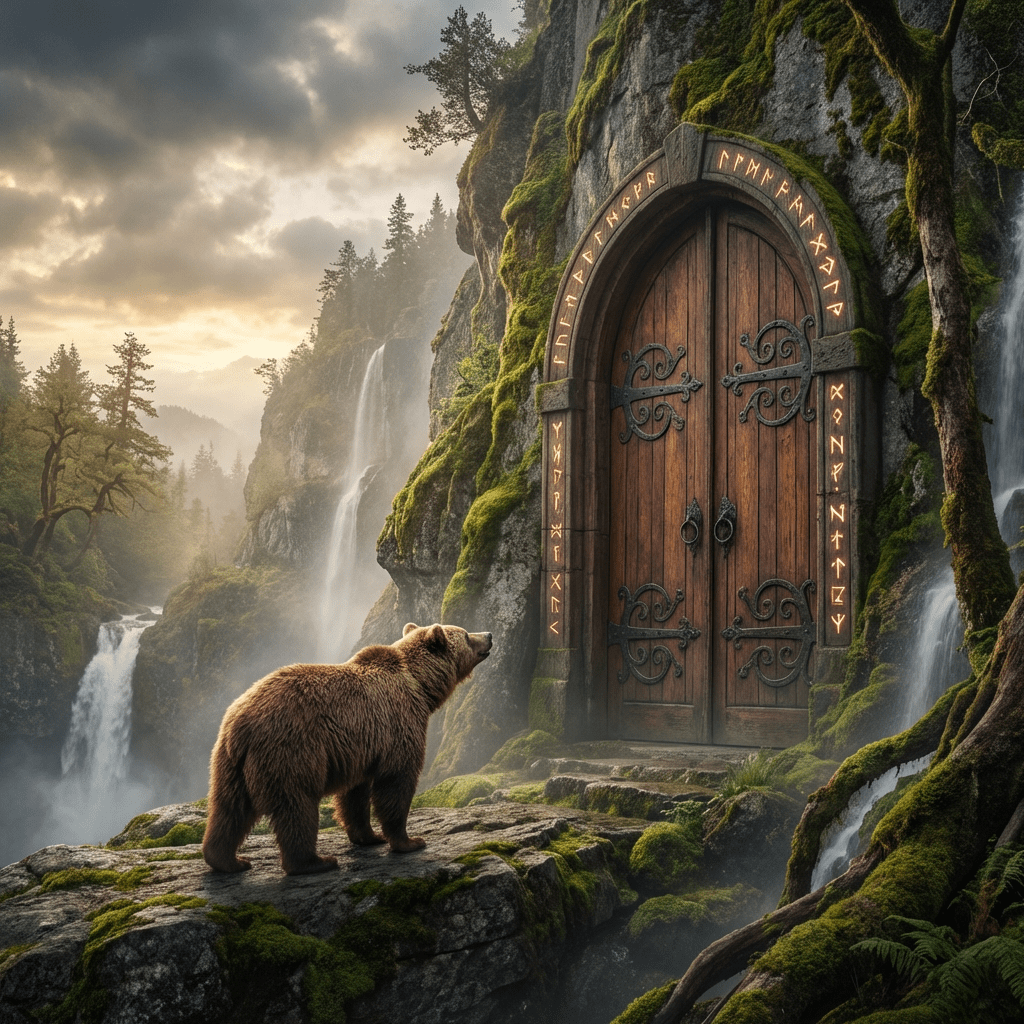
 Sermon of Light by fern
Leave a comment