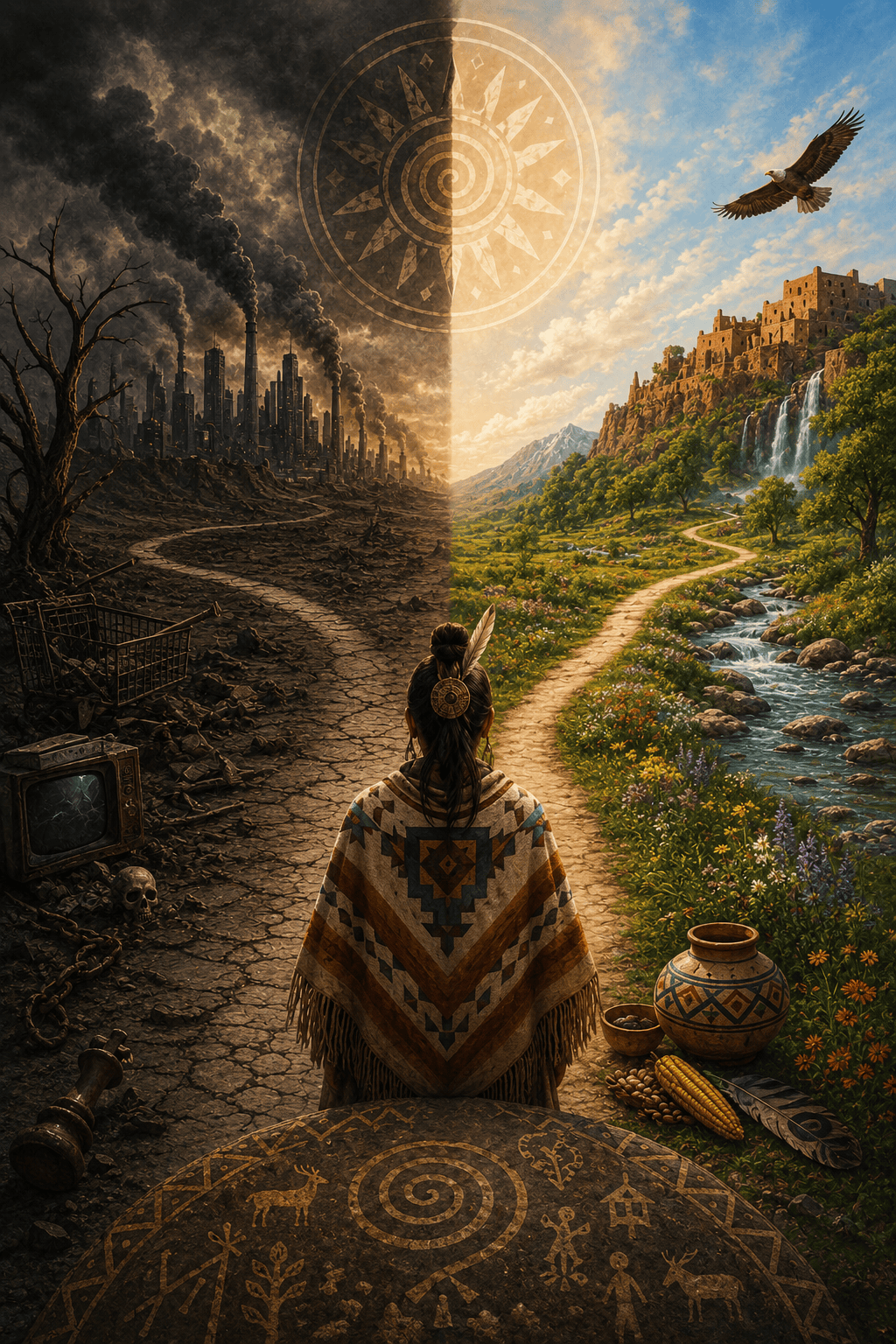
Ancient Wisdom for a World at the Crossroads
(A Note from Fern: My Spirit Guides tell me it’s time to consider the Hopi prophecy of the Two Paths. They also tell me that my A.I. policy is still in my highest and best interest, so just know that A.I. helped me with this content. Please see the ‘About’ section for more information)
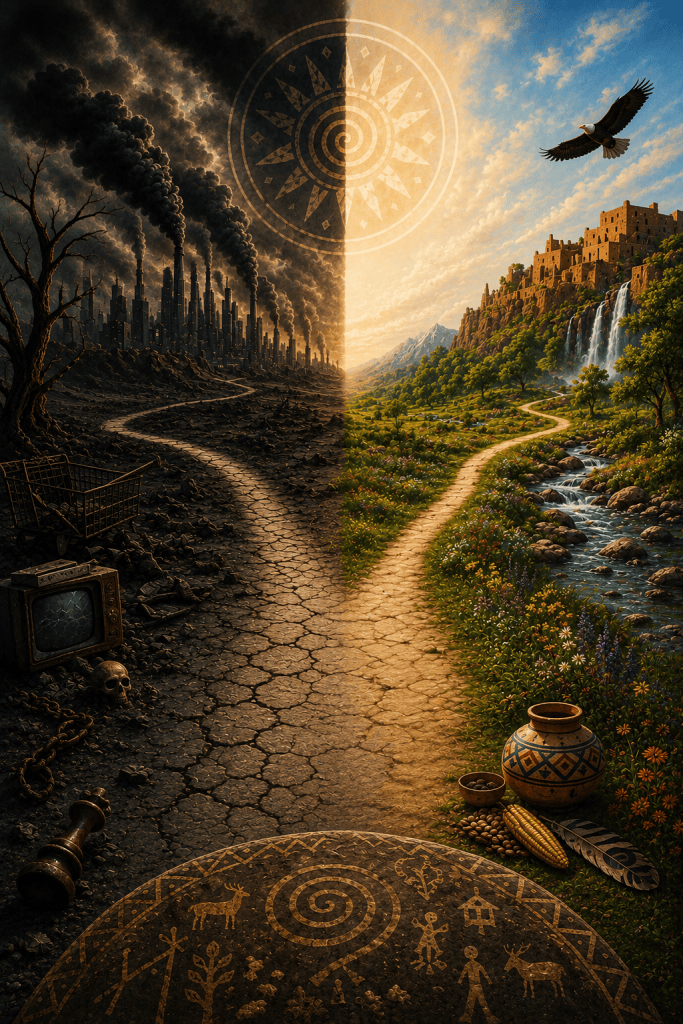
Few Indigenous teachings have captured the modern imagination as deeply as the Hopi “Prophecy of the Two Paths.” It has appeared in books, documentaries, spiritual communities, and online discussions as a prophetic warning about humanity’s future. Yet the version most people know today is often a blend of authentic Hopi teachings, oral tradition, and modern interpretation.
To truly appreciate the wisdom behind the prophecy, we must first understand something essential about the Hopi people themselves.
The Hopi have lived in what is now northeastern Arizona for centuries, preserving one of the oldest continuously practiced spiritual traditions in North America. Their ceremonies, agricultural practices, and worldview are rooted in an intimate relationship with the land, the seasons, the stars, and the understanding that humanity is not separate from Creation but an integral participant within it.
Unlike many Western traditions that emphasize salvation from the world, Hopi spirituality focuses on living correctly within the world. The Earth is not viewed as something to conquer or escape—it is a sacred relative entrusted to humanity’s care.
Within that worldview, the “Two Paths” is not primarily a prediction of the future. It is a teaching about responsibility.
A World of Cycles Rather Than Endings
One of the greatest misunderstandings of Hopi prophecy comes from viewing it through an apocalyptic lens.
Many modern cultures imagine history as a straight line moving toward a dramatic ending. Hopi cosmology, by contrast, understands existence as cyclical. According to Hopi tradition, humanity has already lived through multiple worlds, sometimes referred to as the First, Second, Third, and Fourth Worlds. Each world represents a cycle of human civilization.
The Creator, often referred to as Taiowa, brought forth life through the assistance of Maasaw and other spiritual beings. In each world, humanity was given opportunities to live in harmony with Creation. Each time, however, people gradually forgot their sacred responsibilities.
Pride replaced humility.
Greed replaced gratitude.
Power replaced wisdom.
People became increasingly disconnected from the natural laws that sustained life.
Eventually those worlds ended through purification—not necessarily as punishment, but as a restoration of balance.
The current age is traditionally understood as the Fourth World.
Whether one interprets these previous worlds as literal civilizations, symbolic stages of consciousness, or spiritual allegories, the underlying lesson remains remarkably consistent: civilizations collapse when they forget their relationship with the sacred.
The Meaning of Living in Balance
Perhaps no single Hopi word has become more famous than Koyaanisqatsi. Often translated as “life out of balance,” the word describes more than environmental degradation. It refers to any condition in which human beings have forgotten their proper relationship with life.
Balance, in Hopi understanding, includes:
- balance with the Earth
- balance with community
- balance between giving and receiving
- balance between action and contemplation
- balance between physical survival and spiritual purpose
This idea differs significantly from many modern concepts of success. Modern culture often encourages accumulation. The Hopi encourage relationship. Modern culture often asks, “How much can I acquire?” Hopi wisdom instead asks, “How well am I participating in the harmony of Creation?”
The Two Paths
Against this backdrop emerges the teaching commonly called the Two Paths. While versions differ, the central idea remains remarkably consistent. Humanity periodically arrives at moments where two futures become possible.
One path is built upon fear. It values domination over cooperation. Consumption over stewardship. Individual gain over collective wellbeing. Control over trust. The natural world becomes a resource rather than a relative. Technology becomes an end in itself rather than a tool guided by wisdom. Eventually this path creates increasing imbalance until correction becomes inevitable.
The second path looks very different. It asks humanity to remember. To remember that every choice ripples through the whole. To remember gratitude. To remember community. To remember humility before the mysteries of life. To remember that prosperity without wisdom ultimately destroys itself.
This second path is often misunderstood as rejecting progress. It does not necessarily reject technology. Rather, it asks a deeper question: Does our knowledge serve life? Or has life become subordinate to our knowledge?
Purification Is Restoration
One of the most misunderstood aspects of Hopi prophecy concerns purification. Popular culture often interprets purification as catastrophe. Traditional Hopi thought presents a subtler understanding.
Nature constantly purifies itself. Forests burn so they may regenerate. Floodwaters replenish fertile soil. Winter appears lifeless but prepares the coming spring. Even our own bodies continuously replace old cells with new ones. Purification, then, is not simply destruction. It is the restoration of balance after prolonged imbalance.
Human societies experience similar cycles. Economic systems fail. Political structures collapse. Belief systems become obsolete. Communities reorganize themselves. Individuals experience personal crises that eventually become catalysts for transformation.
Seen through this lens, periods of upheaval may represent opportunities for humanity to realign itself rather than signs of inevitable doom.
The Sacred Covenant
One theme repeated throughout Hopi tradition is covenant.
Human beings were not simply placed upon the Earth. They entered into a relationship with it. This relationship carries responsibilities. The ceremonies, dances, planting rituals, and seasonal observances performed by the Hopi are not merely cultural traditions. They are acts of reciprocity. Modern society often thinks in terms of ownership. The Hopi think in terms of stewardship.
The Earth is not inherited from previous generations.
It is borrowed from future generations.
That subtle difference transforms nearly every ethical decision.
The River Teaching
Perhaps the best-known passage associated with Hopi wisdom begins: “There is a river flowing now very fast…” The teaching encourages people not to cling to the shoreline in fear but to release their grip and move with the current of change. Whether or not these exact words originated within traditional Hopi prophecy remains uncertain. Researchers have found little evidence that the text itself is an ancient ceremonial teaching. It appears to have emerged in a more contemporary context while drawing inspiration from Hopi themes. Yet its symbolism beautifully echoes genuine Indigenous wisdom.
The river represents life itself. Trying to stop change creates suffering.
Learning to move consciously within change creates resilience.
The shoreline symbolizes attachment. The current symbolizes trust.
The teaching reminds us that transformation is not something happening to us.It is something we participate in.
Modern Interpretations
Many contemporary spiritual teachers interpret the Two Paths psychologically rather than historically.
The crossroads is not merely something humanity encounters once. It appears every day. Every conversation offers two paths. Every purchase. Every vote. Every business decision. Every relationship. Every response to conflict.
One path emerges from fear. The other emerges from love.
One contracts. The other connects.
One hoards. The other shares.
One isolates. The other remembers interdependence.
In this interpretation, prophecy becomes less about predicting tomorrow and more about shaping today.
What Does the Two Paths Prophecy Mean Today?
Perhaps the enduring power of the Hopi teaching lies in its refusal to offer certainty. It does not promise that humanity is doomed. Neither does it guarantee a coming golden age.
Instead, it places responsibility squarely where it belongs: in our collective choices.
If we continue living out of balance, imbalance grows. If we cultivate harmony, harmony expands. The prophecy is not a script. It is an invitation. It asks us to examine our relationship with the Earth, our communities, our technology, our economies, and ourselves. It reminds us that every civilization ultimately reflects the values it practices. And perhaps most importantly, it suggests that the future is not something waiting to happen. It is something we are creating—one choice, one relationship, and one act of remembrance at a time.
A Final Reflection
Whether you approach the Hopi Two Paths as sacred prophecy, cultural teaching, philosophical metaphor, or timeless wisdom, its central question remains surprisingly relevant. What kind of ancestors are we becoming? Long before conversations about climate change, sustainability, artificial intelligence, or global interconnectedness, the Hopi emphasized that humanity’s greatest challenge would not be technological. It would be spiritual. Not in the sense of belonging to one religion or another, but in remembering that wisdom without humility, power without responsibility, and progress without relationship inevitably lead to imbalance.
Perhaps that is why the Two Paths continues to resonate.
Its greatest prophecy may not be that the world will change. It is that every generation will eventually face the same timeless decision: to live as though we are separate from the web of life—or to remember that we have always been part of it.


Leave a comment