There is a beautiful idea in many spiritual traditions that our inner state does not belong entirely to us.
When we become more peaceful, more authentic, more loving, more coherent, something changes—not only within us, but in the space we share with other people.
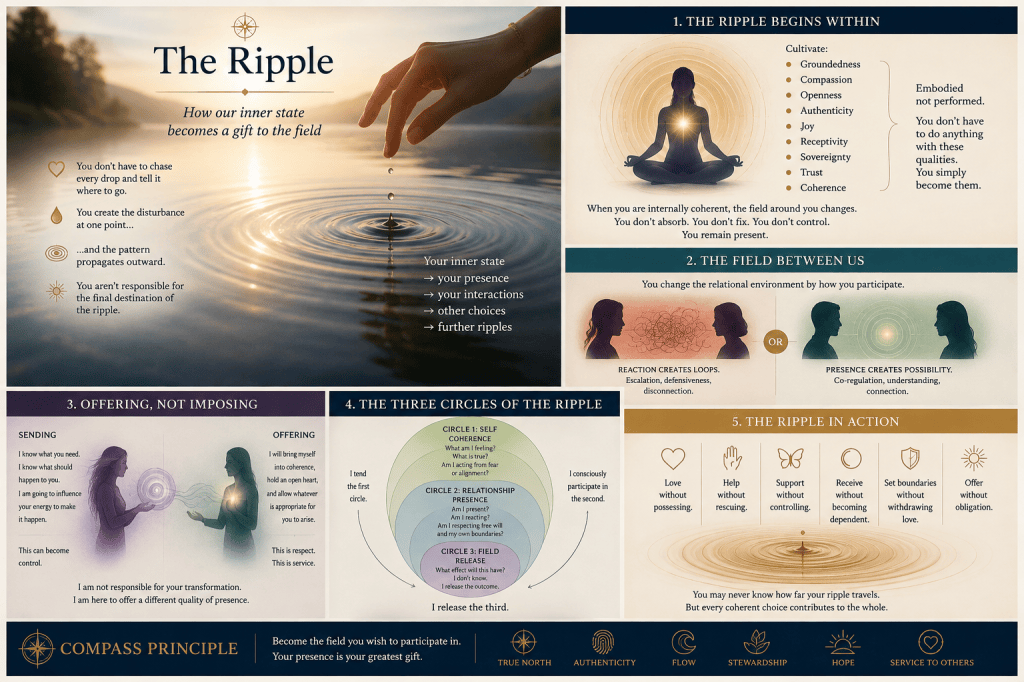
We might call this the ripple.
The metaphor is simple: drop a stone into a pond, and the disturbance travels outward. The stone doesn’t chase the ripples. It doesn’t direct them. It simply enters the water, and the movement propagates.
Perhaps consciousness works in a similar way.
When we cultivate a particular quality of being, we bring that quality into every relationship, conversation, room, and encounter we enter. We don’t necessarily need to convince anyone, heal anyone, teach anyone, or change anyone.
We simply participate differently.
And that difference can ripple.
The Ripple Begins Within
Imagine cultivating groundedness, compassion, openness, authenticity, joy, receptivity, sovereignty, and trust. These qualities aren’t necessarily things we perform. They are qualities we gradually embody.
Someone who is anxious enters the room. Someone who is angry speaks sharply. Someone is frightened, defensive, grieving, or confused.
Our instinct may be to meet their energy with our own.
Their anxiety activates ours. Their anger triggers our defensiveness. Their defensiveness makes us defensive in return.
And suddenly, without consciously choosing it, we are participating in a feedback loop.
But what happens when we become more internally coherent?
The other person’s anxiety may still be there. Their anger may still be there. Their pain may still be there.
But we don’t necessarily have to reproduce it.
We can breathe. We can listen. We can remain present. We can respond instead of react. We can maintain compassion without absorbing their experience.
And something subtle changes; the field between us changes.
From Reaction to Co-Regulation
There is an ordinary psychological explanation for some of this.
Human beings constantly perceive one another through facial expressions, tone of voice, posture, pacing, attention, and emotional cues. A regulated person can sometimes help another person regulate. A calm presence can interrupt an escalating feedback loop.
Consider the difference between these two interactions:
Criticism → defensiveness → escalation → greater defensiveness → greater escalation
versus:
Criticism → presence → thoughtful response → reduced escalation → possibility of connection
Nothing magical has to be assumed for this to happen. Our way of participating in a relationship changes the relationship itself.
But spiritual traditions invite us to take the idea one step further.
What if consciousness itself is interconnected? What if our state of being participates in something larger than the individual self?
This is where the concept of the Law of One becomes particularly interesting.
Service Without Control
The Law of One describes spiritual evolution through the concept of polarity, particularly Service-to-Others and Service-to-Self.
At its heart, the positive polarity is an orientation toward connection, love, and service to other-selves.
But there is an important distinction between service and control.
We can easily imagine service as doing things for other people: Fixing them. Saving them. Teaching them. Healing them. Giving them what we think they need.
But there is another form of service that is much quieter: presence. Instead of asking, How can I change this person? we might ask, What am I contributing to the space between us? Instead of, How can I get them into a better state? we might ask, Can I remain in love while they are where they are?
That is a profound shift and it transforms service from an act of intervention into an offering.
The Difference Between Sending and Offering
This distinction becomes especially important when we talk about “energy.”
It is tempting to imagine that we can simply send loving energy into another person’s field and cause them to heal or change.
But there is a subtle problem with that idea. It can contain an assumption: I know what you need. I know what should happen to you. I am going to influence your energy until you become different. That may sound loving, but it can quietly become another form of control and it does not respect the other person’s free will.
A more balanced approach is: I will bring myself into coherence, hold an open heart, and allow whatever is appropriate for this person to arise. I’m not responsible for their transformation. I’m not entitled to their healing. I’m not here to override their choices. I am simply offering a different quality of presence. And then I let go.
That is where service and sovereignty meet.
The Wisdom of Receptivity, of the Balanced Feminine Archetype
This is also where the idea of balanced feminine energy becomes especially powerful.
If we use “feminine energy” symbolically—not as a prescription for how women should behave, but as an archetypal quality—it often includes the qualities of receptivity, intuition, embodiment, relational awareness, creativity, nurturing, and allowing.
But balanced receptivity is not passivity. It doesn’t mean absorbing everyone else’s emotions. It doesn’t mean saying yes to everything. It doesn’t mean sacrificing ourselves for other people. It doesn’t mean becoming a spiritual sponge.
Healthy receptivity has boundaries. It says: I can remain open without losing myself. I can listen without absorbing. I can love without rescuing. I can care without controlling. I can receive without becoming dependent. I can say no without withdrawing love.
This is a profoundly different kind of feminine energy from the old archetype of the self-sacrificing woman who exists primarily to take care of everyone else.
Service Is Not Self-Abandonment
This may be one of the most important distinctions we can make.
There is a version of “Service-to-Others” that looks remarkably like self-erasure: Everyone else comes first. My needs don’t matter. If someone needs me, I have to help. I should always be available. Setting boundaries is selfish.
But self-abandonment is not necessarily spiritual service. In fact, genuine service requires a self capable of making a free choice.
There is a profound difference between: “I have to help you.” and: “I freely choose to offer myself here.” The first can contain fear, guilt, obligation, or the need to be needed. The second contains sovereignty, and sovereignty changes everything.
The Balanced Feminine Does Not Say, “I Exist for You.”
Nor does she have to say: “I exist only for myself.”
There is a third possibility: “I belong to myself—and because I belong to myself, I can freely choose to participate in something greater than myself.”
That is the space where balanced feminine energy and Service-to-Others begin to converge. The self is not discarded. The other is not dominated. Instead, both are honored.
Self and Other.
Not Self versus Other.
And if we take the Law of One’s premise seriously—that all beings are ultimately expressions of the One Creator—then caring for another does not ultimately require abandoning ourselves. Nor does caring for ourselves require abandoning the other.
The apparent separation begins to soften.
Becoming the Field
Perhaps, then, the most powerful form of energetic influence isn’t sending anything at all. Perhaps it is becoming. Becoming peaceful, honest, compassionate, discerning, joyful, grounded, authentic, willing to receive, willing to say no, willing to love without possessing…
And then bring that person into the world, into your marriage, into your friendships, into your parenting, into your workplace, into a difficult conversation, into a grocery store, into a room where someone is hurting.
You don’t have to announce your state. You don’t have to tell anyone what you’re doing.
You simply arrive differently.
And other people encounter that difference.
The Three Circles of the Ripple
One way to understand this is through three concentric circles.
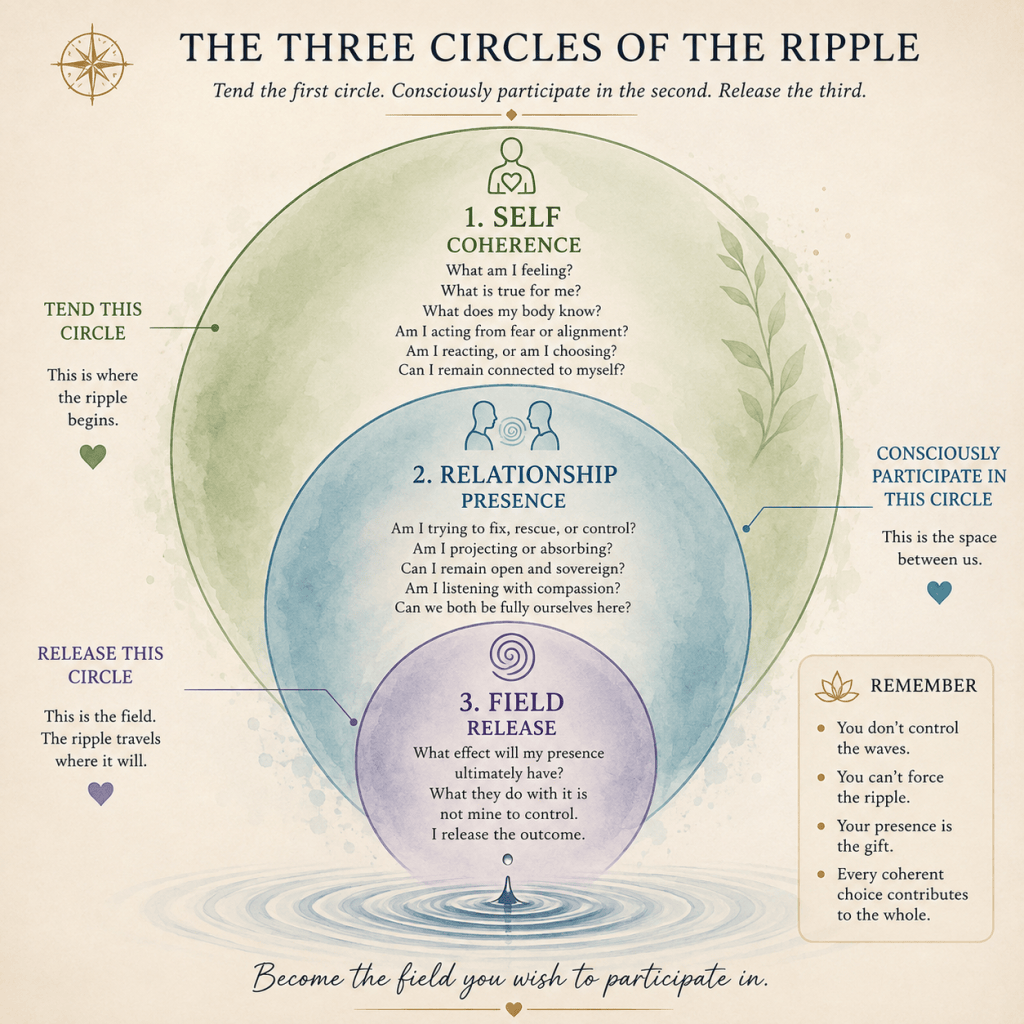
Circle One: Self — Coherence
Begin within.
What am I feeling? What is true for me? What does my body know? Am I acting from fear or alignment? Am I reacting, or am I choosing? Can I remain connected to myself?
This is where the ripple begins.
Circle Two: Relationship — Presence
Then comes the space between you and another person.
Am I trying to fix them? Am I rescuing? Am I controlling? Am I projecting? Am I absorbing? Can I remain open and sovereign at the same time?
This is where the ripple becomes relational.
Circle Three: Field — Release
And finally, there is everything beyond our control.
What effect will my presence ultimately have? Will this person change? Will they understand? Will they heal? Will they respond differently?
We don’t know. And we don’t need to know.
We tend the first circle.
We consciously participate in the second.
We release the third.
That may be one of the most important spiritual boundaries we can learn.
Love Does Not Require Access
There is another beautiful consequence of this understanding. Sometimes the most loving thing we can do is establish a boundary.
Someone may behave destructively toward us. We can love them—and leave. We can say: “I love you, and I am not willing to participate in this dynamic.” That isn’t necessarily rejection. It can be sovereignty. It can be compassion without complicity. It can be an expression of love that refuses to control the other person while also refusing to abandon the self.
And that boundary becomes part of the ripple, too.
Someone watching us establish a healthy boundary may discover that they are allowed to establish one themselves. Someone watching us speak honestly may find permission to tell the truth. Someone encountering our authenticity may realize they don’t have to keep pretending. Someone experiencing our calm may remember what calm feels like.
We may never know that we influenced them and that is the nature of a ripple.
We Don’t Get to Control the Waves
This may be the most liberating part.
We don’t get to decide where the ripple goes. We don’t get to know how far it travels. We don’t get to determine what another person does with what they encounter in us.
And we don’t have to.
Our responsibility is not to control the field. Our responsibility is to become conscious of what we are contributing to it.
Fear creates one kind of ripple. Resentment creates another. Judgment creates another.
Love creates another. Authenticity, Peace, Courage, and Joy create others.
And none of these ripples require us to become perfect. They simply require us to become increasingly conscious.
The Quiet Power of Being
Perhaps this is ultimately what spiritual service looks like when it has matured beyond rescuing.
Not: “I have to save everyone.” But: “I can stand beside you.”
Not: “I need to heal you.” But: “I can hold a loving space while you walk your own path.”
Not: “I must give everything I have.” But: “I can offer what is mine to offer, freely and without abandoning myself.”
Not: “I need to change the world.” But: “I can change the way I participate in the world.”
And perhaps that is enough. A ripple doesn’t need to know where it is going to matter; It simply moves.
The Ripple
Become coherent.
Become authentic.
Become loving.
Become receptive.
Become sovereign.
Offer yourself freely.
Respect everyone else’s path.
And then let consciousness do what consciousness does.
You create the disturbance.
You don’t dictate the waves.
And somewhere beyond what you can see, the field changes.


Leave a comment