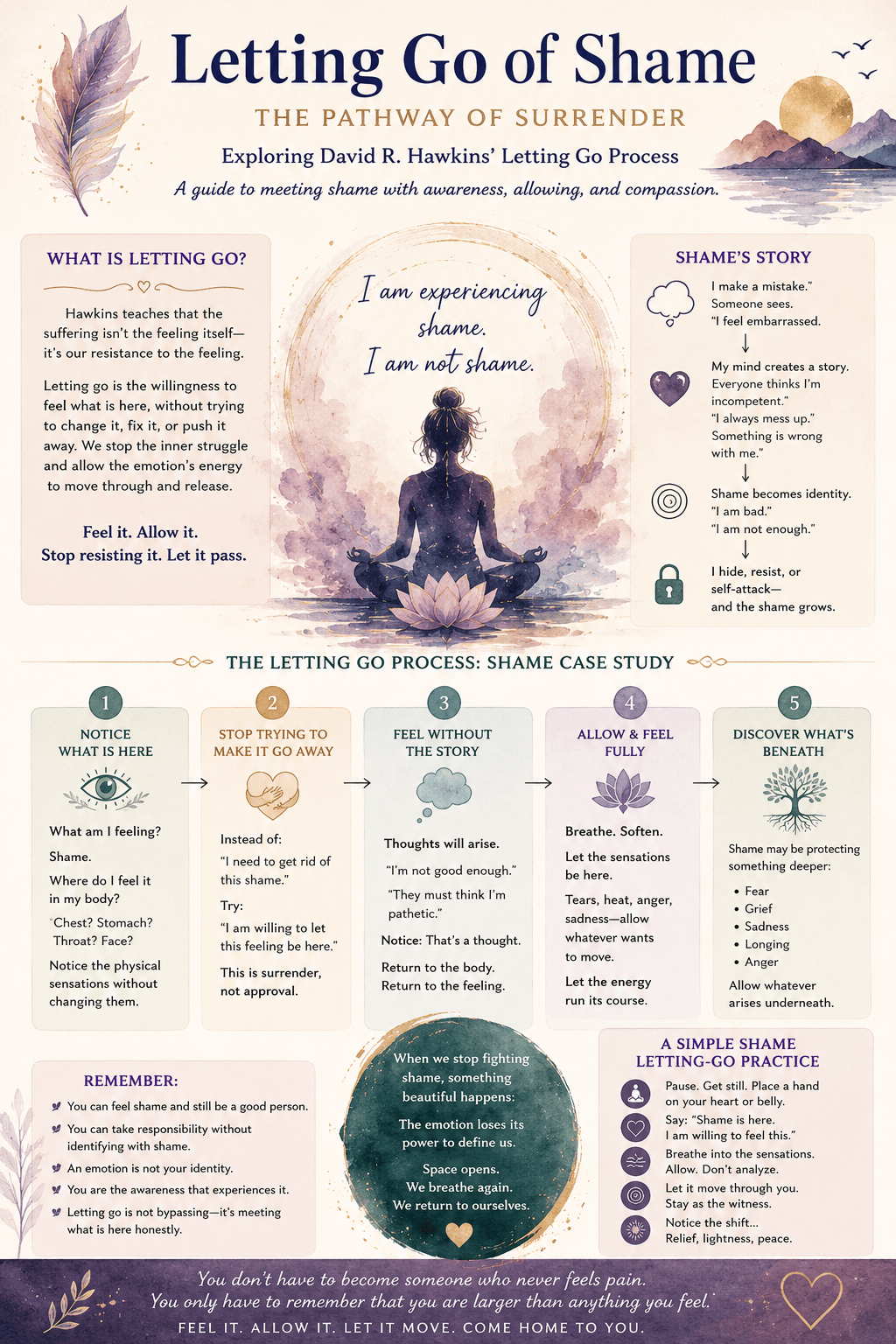
Exploring David R. Hawkins’ Pathway of Surrender through the emotion of shame
There is a particular kind of suffering that comes from wanting desperately to stop feeling something. Fear makes us want to escape. Anger makes us want to fight. Grief makes us want to retreat.
But shame is different.
Shame whispers: “There is something wrong with me.” It doesn’t simply say, I did something wrong. It says, I am wrong. And because shame can become intertwined with our identity, trying to “get rid of” shame can paradoxically strengthen it. We begin fighting ourselves.
This is where David R. Hawkins’ concept of letting go offers an intriguing alternative.
In Letting Go: The Pathway of Surrender, Hawkins presents surrender as a way of allowing an emotion to be fully experienced without suppressing it, expressing it onto others, escaping from it, or continuously feeding it with thought. His stated purpose is to release what he describes as emotional blocks to greater freedom and consciousness.
The essential movement is remarkably simple:
Feel it. Allow it. Stop resisting it. Let it move through you.
The goal is not to force the feeling to disappear.
It is to stop fighting the fact that the feeling is here.
What Does “Letting Go” Actually Mean?
Hawkins describes letting go as an internal surrender rather than an external action.
Imagine that you are carrying a heavy backpack. You could spend hours thinking about how heavy it is. You could become angry that someone put the backpack on you. You could blame yourself for carrying it. You could convince yourself that you deserve to carry it.
Or you could simply put it down.
For Hawkins, emotional surrender works in a similar way. We often experience an emotion and then immediately add layers of resistance: “I shouldn’t feel this.”
“Why am I still like this?” “This is ridiculous.” “I need to get over it.” “They shouldn’t have done that.” “What does this say about me?”
The original emotion becomes surrounded by thought. Hawkins’ method asks us to step out of that mental struggle and experience the emotion itself. His description of the process emphasizes awareness of the feeling, allowing it to be present, and letting its energy run its course rather than trying to modify or control it. This distinction becomes particularly powerful with shame.
Shame: The Emotion That Says “I Am the Problem”
Consider a hypothetical situation.
You make a mistake at work. Someone points it out in front of other people.
Your face gets hot. Your stomach drops. Your chest tightens.
And almost instantly, your mind begins producing a story: How could I be so stupid?
Then: Everyone thinks I’m incompetent.
Then: I always screw things up.
And finally: What’s wrong with me?
Notice what happened.
The original experience may have been embarrassment. But the mind transformed embarrassment into shame. Then shame became self-condemnation. And eventually self-condemnation became identity.
I made a mistake → I am bad at things → I am inadequate → there is something fundamentally wrong with me.
This is precisely where the practice of letting go becomes interesting. Instead of following the story, we turn toward the feeling.
Step One: Notice What Is Actually Here
The first question isn’t: “Why am I ashamed?” It is: “What am I feeling?”
Perhaps the answer is: Shame. Don’t argue with it. Don’t try to make it more spiritual. Don’t tell yourself that you shouldn’t feel ashamed.
Just acknowledge: “Shame is here.”
Then move beneath the label and notice the physical experience.
Perhaps there is:
- tightness in the chest
- heat in the face
- a sinking sensation in the stomach
- pressure in the throat
- an urge to hide
- heaviness behind the eyes
- tension in the shoulders
This is important because shame is not merely a thought. It is an embodied experience.
So instead of continuing to rehearse the story, we become curious about the sensation. Where is the shame in my body?
Step Two: Stop Trying to Make It Go Away
This is perhaps the counterintuitive heart of the practice.
We don’t say: “I need to release this shame.” Because that can subtly communicate: “Shame is unacceptable, and I need to get rid of it.”
Instead: “I am willing to let this feeling be here.”
There is enormous psychological and spiritual space between those two statements.
The first is resistance. The second is surrender. You aren’t saying that the shame is justified. You aren’t saying that the story attached to it is true. You aren’t saying that you did nothing wrong. You’re simply saying: “This is what I am experiencing right now, and I don’t need to fight the experience.”
Step Three: Feel the Emotion Without Feeding the Story
This is where the practice becomes subtle.
Suppose the mind says: Everyone thinks I’m incompetent.
Rather than arguing: “No, they don’t!” we simply notice:
That’s a thought.
And return to the feeling. What does shame feel like right now?
Perhaps the chest tightens. Stay there.
Breathe.
Allow the sensation.
The mind might produce another thought: I’m such an idiot.
Again: That’s a thought.
Return to the body.
The purpose isn’t to suppress thoughts. It’s simply to stop giving the thoughts the job of defining reality. You are experiencing shame. You are not the shame.
That distinction can become profound.
Step Four: Let Yourself Fully Experience the Shame
This is where “letting go” can feel almost paradoxical.
We are accustomed to believing that healing means moving away from painful emotions. Hawkins proposes moving toward them instead.
Not through rumination. Not through self-punishment. Not through deliberately making yourself miserable. But through willingness.
You might quietly say: “Okay. Let me feel this.” And then simply remain present.
If tears come, let them come. If your body trembles, notice it. If anger appears, allow the anger. If sadness emerges underneath the shame, allow the sadness.
You don’t have to decide what should happen next.
You’re simply allowing the emotional experience to unfold.
Hawkins describes the eventual experience of surrender as potentially involving a reduction of inner pressure and a sense of relief or lightness.
Step Five: Discover What Is Beneath the Shame
This is where shame becomes particularly interesting. Sometimes shame isn’t the deepest emotion. It may be protecting something underneath it.
You might discover:
Shame → fear
“I’m afraid people will reject me.” Or:
Shame → grief
“I desperately wanted to be good enough.” Or:
Shame → sadness
“I wish someone had told me I was okay.” Or:
Shame → longing
“I want to be loved exactly as I am.” Or even:
Shame → anger
“I am tired of believing I have to be perfect to deserve love.”
You don’t have to deliberately excavate these emotions. Simply let the experience unfold. If another emotion arises, you can apply the same process to that emotion.
- Notice it.
- Allow it.
- Feel it.
- Don’t resist it.
- Don’t become it.
- Let it move.
The Most Important Distinction: “I Feel Shame” vs. “I Am Shameful”
This may be the most transformative aspect of the practice.
Compare: “I am ashamed because there is something wrong with me.”
with: “I am experiencing shame.”
The first statement fuses the emotion with identity. The second creates awareness.
There is an experiencer. And there is an experience.
The emotion is present, but it isn’t the entirety of who you are.
This is consistent with Hawkins’ larger framework, in which surrender is intended to loosen identification with limiting emotional states and ultimately remove obstacles to greater awareness. And regardless of whether one accepts Hawkins’ larger metaphysical model, this distinction is useful as a contemplative practice.
An emotion can be real without being your identity.
What About Responsibility?
This is an important question.
Letting go does not have to mean letting yourself off the hook. Suppose you genuinely hurt someone. You can acknowledge: “I did something I regret.” You can apologize. You can repair the damage. You can learn. You can change your behavior.
And simultaneously release: “Therefore I am a terrible person.”
Healthy responsibility says: I did something wrong. What can I do about it?
Shame says: I am wrong. There is nothing I can do about who I am.
Letting go can therefore be understood not as avoiding accountability, but as releasing the emotional identification that prevents meaningful change.
A Shame Letting-Go Practice
Imagine sitting quietly after experiencing something that triggered shame.
You might work through it like this: What am I feeling? Shame. Can I allow myself to feel this? Yes. Where do I feel it? My chest. My stomach. My face.
Can I allow those sensations to be here without trying to change them? Yes.
Then breathe.
Don’t analyze. Don’t justify. Don’t condemn yourself.
Just feel.
If the mind says: I’m not good enough. Notice: Thought. Return to the body.
If the mind says: Everyone must think I’m pathetic. Notice: Thought. Return to the body.
If another emotion appears: Fear. Allow the fear. If sadness appears: Sadness. Allow the sadness. And eventually, perhaps, something changes.
The chest softens.
The breath becomes deeper.
The pressure decreases.
You may experience nothing dramatic at all.
That’s okay.
The point isn’t to manufacture a mystical release.
The point is willingness.
The Deeper Question: What Happens When I Stop Fighting Myself?
This may be the most beautiful question hidden inside the practice.
Shame survives remarkably well in an environment of internal warfare.
One part of us feels ashamed. Another part says: “Stop feeling ashamed!”
Then another says: “Why can’t you get over this?” And another says: “You’re doing healing wrong.”
Suddenly we’re ashamed of being ashamed.
Letting go interrupts that cycle.
Instead of: Emotion → resistance → judgment → more emotion → more resistance, we practice: Emotion → awareness → allowing → surrender. And sometimes the thing that finally dissolves isn’t the original emotion. What dissolves is the fight against the emotion. That is a subtle but profound difference.
From Shame Toward Freedom
Hawkins’ model proposes that as emotional states are surrendered, one becomes less dominated by them and increasingly able to experience states such as acceptance and peace. In his writings, he describes surrender as something that can be practiced repeatedly in ordinary life rather than only during formal meditation.
Whether we interpret that spiritually or psychologically, there is something deeply human about the practice.
We don’t have to wait until we’re completely healed before we can accept ourselves. We don’t have to eliminate every difficult emotion before we are worthy of love. We don’t have to turn every wound into a lesson.
Sometimes healing begins much more simply: This hurts. This is here. I don’t have to run from it. I don’t have to become it. I can allow myself to experience it. And perhaps, little by little, the thing we were so afraid to feel becomes something we discover we can survive.
Then something even more surprising can happen. The emotion that once seemed to define us becomes simply… an experience that passed through us. And underneath it, there was still a Self, capable of witnessing it.
Still here.
Still whole.
Still worthy.
Perhaps that is one of the deepest meanings of letting go: not forcing ourselves to become someone who never feels pain, but discovering that we are larger than anything we feel.


Leave a comment