Seals, Trumpets, Bowls, and the Movement from Logos to Unity
Introduction
The number seven occupies a position of unusual prominence in the biblical Book of Revelation. Seven churches, seven spirits, seven lampstands, seven stars, seven seals, seven trumpets, seven bowls, and numerous other septenary structures organize the visionary narrative. The recurrence of seven is not merely decorative. It provides Revelation with an architectural principle through which history, judgment, revelation, and transformation are represented as stages within a larger sacred order.
Among these structures, the Seven Seals are particularly significant. In Revelation 5–8, a scroll held in the heavenly realm is sealed with seven seals. The Lamb, identified with Christ, is found worthy to open the scroll. With each seal, John receives another vision: the Four Horsemen, the souls of the martyrs, cosmic upheaval, and finally silence in heaven. The opening of the seventh seal subsequently introduces the Seven Trumpets, which themselves participate in the larger movement toward the Seven Bowls. This creates a striking threefold sequence: Seals → Trumpets → Bowls Symbolically, these can be understood as three movements: Opening → Proclamation → Completion
The present essay explores this structure through a comparative symbolic framework in which the seven positions are understood as stages of differentiation, crisis, transformation, revelation, and return. It further places the biblical imagery in dialogue with a broader sevenfold model involving Logos, Wisdom, Christ, creation, consciousness, and unity.
This approach should be understood as comparative symbolism rather than biblical exegesis in the strict historical-critical sense. Revelation does not explicitly identify the Seals with the Elohim, Archons, chakras, or other sevenfold systems. Those correspondences belong to later interpretive frameworks. The purpose of the matrix is therefore not to claim historical identity among these traditions, but to investigate whether recurring sevenfold patterns reveal a common symbolic grammar.

I. Seven as Sacred Architecture
Seven frequently functions in biblical literature as a number of completion. Its importance is already apparent in the creation narrative of Genesis, where the seventh day marks the completion and sanctification of the creative sequence.
Revelation intensifies this numerical symbolism. Rather than presenting its visions as a simple chronological list, the book repeatedly organizes its material into groups of seven. The result is a literary architecture in which the seventh element often functions simultaneously as completion and transition.
This is particularly evident in the Seven Seals.
The first six seals produce increasingly dramatic manifestations, but the seventh produces something different: silence. Revelation 8:1 describes approximately half an hour of silence in heaven after the seventh seal is opened. Immediately afterward, the seven angels receive seven trumpets.
Thus, the seventh seal does not merely terminate the sequence. It opens another sequence. The seventh therefore possesses a liminal quality: The seventh completes one octave while preparing the next. This observation provides the foundation for a broader sevenfold model.
II. The Seven Seals
The Seven Seals may be summarized as follows:
| Seal | Revelation imagery | Symbolic movement |
| I | White horse and conquering rider | Will / outward movement |
| II | Red horse and removal of peace | Polarity / conflict |
| III | Black horse and scales | Value / scarcity |
| IV | Pale horse and Death | Dissolution / transformation |
| V | Martyrs beneath the altar | Sacrifice / remembrance |
| VI | Earthquake and cosmic signs | Revelation / destabilization |
| VII | Silence in heaven | Completion / threshold |
The progression can be read as movement from the human sphere toward the cosmic sphere. The first four seals are dominated by forces operating within earthly existence: conquest, war, economic scarcity, and death. The fifth introduces the spiritual dimension of suffering and memory. The sixth expands the disturbance to the cosmic order itself. The seventh then suspends activity altogether.
The movement is therefore approximately: Action → Conflict → Scarcity → Death → Memory → Cosmic Revelation → Silence
This is not necessarily a prediction of seven discrete historical events. As visionary literature, Revelation uses symbolic images to communicate theological claims about the instability of worldly power, divine judgment, martyrdom, and the ultimate transformation of creation.
III. The Sevenfold Matrix
The symbolic matrix developed here interprets the seven positions as successive dimensions of experience:
| I | II | III | IV | V | VI | VII | |
| Principle | Will | Polarity | Value | Form | Sacrifice | Revelation | Unity |
| Seal | White Horse | Red Horse | Black Horse | Pale Horse | Martyrs | Cosmic Upheaval | Silence |
| Human question | What do I pursue? | Who is Other? | What has value? | What must change? | What has my suffering meant? | What is actually real? | What remains when all is still? |
| Spiritual process | Intention | Differentiation | Discernment | Surrender | Integration | Illumination | Union |
| Movement | Outward | Dividing | Evaluating | Dissolving | Remembering | Awakening | Returning |
This interpretation does not claim that the biblical author consciously encoded these precise categories. Rather, it demonstrates how the imagery can participate in a coherent sevenfold symbolic reading.
The most important feature of the model is its directionality. The sequence begins with movement and ends with stillness. It begins with differentiation and ends with unity. It begins with the experience of an external world and culminates in a suspension of ordinary activity.
IV. The White Horse: Will and Initiation
The first seal introduces the white horse and its rider. The rider carries a bow and receives a crown before going out conquering. Interpretations of this figure have varied considerably. Some have identified the rider positively with Christ or victorious righteousness; others have understood him as conquest or deceptive imitation.
Within the sevenfold matrix, the ambiguity itself is significant.
The first stage represents directed will. Before there can be conflict, scarcity, transformation, or revelation, something must move outward. The archetypal question is: What is consciousness attempting to accomplish? This is the beginning of manifestation: intention becoming movement.
V. The Red Horse: Polarity
The second seal introduces the red horse. Its rider receives a great sword and removes peace from the earth. The symbolic structure here is unmistakably relational. The first movement outward encounters resistance, difference, and opposition.
Thus: Will → Polarity
Once consciousness differentiates itself into subject and object, self and other, friend and enemy, conflict becomes possible. In a metaphysical interpretation, polarity is not necessarily evil. Differentiation is what makes experience possible. The problem emerges when differentiation becomes absolute and relationship is replaced by opposition. The second stage therefore represents the birth of duality.
VI. The Black Horse: Value and Scarcity
The third seal introduces the black horse and a rider carrying scales. Commodity prices become extraordinarily high, creating an image of economic scarcity.
The scales introduce another dimension: measurement.
The question is no longer merely whether two forces are opposed. The question becomes: What is worth what?
The third stage therefore concerns value, exchange, resources, measurement, and discernment. In psychological terms, this is the formation of an internal economy: attention, energy, loyalty, time, and desire are allocated according to perceived value. Scarcity distorts that process. The third seal therefore represents not merely famine but the crisis of value itself.
VII. The Pale Horse: Death and Transformation
The fourth seal introduces the most explicit personification in the sequence: Death, followed by Hades. Here the previous stages reach their logical consequence. Will produces action. Action produces conflict. Conflict produces scarcity. Scarcity and conflict eventually confront mortality.
The fourth position therefore represents the limit of form.
Every manifested structure is temporary. What is created can decay; what is organized can dissolve; what is identified as permanent eventually encounters change. In the matrix, death is consequently interpreted not only as destruction but as transformation through the relinquishment of form. This becomes important for the later Christological reading.
VIII. The Fifth Seal: Sacrifice and Memory
The fifth seal differs dramatically from the first four. John sees the souls of those who have been killed because of their testimony. They are beneath the altar and cry out for justice. The central theme becomes memory.
The dead have not simply disappeared from the narrative. Their suffering has become testimony.
This produces a profound symbolic transition: Death → Meaning
The fifth stage asks whether suffering can be integrated into a larger moral order. The martyrs’ question—when justice will come—also introduces temporality. The world has not yet been resolved. Something remains incomplete. The fifth position can therefore be interpreted as sacrificial consciousness: the recognition that transformation often requires the surrender of an identity, attachment, or previous form.

IX. The Sixth Seal: Revelation and the Collapse of the Old Cosmos
With the sixth seal, the scale changes dramatically. An earthquake occurs. The sun becomes dark, the moon appears like blood, stars fall, and the heavens themselves are shaken.
The imagery is cosmic because the transformation has reached the level of the world-picture itself.
In symbolic psychology, the heavens can represent the structures through which reality is interpreted. When the heavens shake, the old cosmology can no longer provide sufficient order. The sixth stage therefore represents: The collapse of the old map of reality.
This is why revelation and apocalypse are intimately connected. The Greek word apokalypsis carries the sense of uncovering or unveiling. Apocalypse is therefore not simply catastrophe. It is disclosure. Something hidden becomes visible precisely because the old structures that concealed it are being dismantled.
X. The Seventh Seal: Sacred Silence
The seventh seal produces perhaps the strangest event in the sequence: silence in heaven.
After conquest, war, scarcity, death, martyrdom, and cosmic upheaval, the narrative does not culminate in another explosion of activity. It stops. This silence can be interpreted as a liminal state between worlds.
It is neither ordinary existence nor the next phase of revelation. It is the still point between them. Within the sevenfold model, the seventh position therefore represents: Completion → Stillness → Potential This is why the seventh is better understood as a threshold than as an endpoint. The seventh seal closes one sequence while giving birth to another.
XI. Seals, Trumpets, and Bowls
The larger structure of Revelation can now be understood as three sevenfold movements:
- The Seals — Opening The seals are progressively broken. Their fundamental image is uncovering. What has been hidden is revealed.
- The Trumpets — Proclamation The trumpets sound. Their fundamental image is announcement. What has been revealed is proclaimed.
- The Bowls — Completion The bowls are poured out. Their fundamental image is actualization or consummation. What has been proclaimed reaches its culmination.
The seventh element of each series consequently participates in a larger movement toward completion.
XII. Logos, Wisdom, and Christ
The sevenfold Revelation matrix becomes particularly interesting when placed alongside the Logos–Wisdom–Christ model.
In Johannine theology, the Logos represents the divine Word through which creation and divine self-expression are understood. Wisdom traditions, meanwhile, frequently personify divine Wisdom as an ordering and mediating principle. Christ occupies a distinctive position in this theological framework because the Logos becomes embodied. The Lamb in Revelation occupies a particularly important symbolic position within this architecture. The Lamb is the one who is worthy to open the scroll. Christ is therefore not merely another participant in the apocalyptic process. The Lamb is the mediator through whom the hidden order becomes accessible.
In symbolic terms:
- The Logos contains the pattern.
- The Lamb opens the pattern.
- Revelation discloses the pattern.
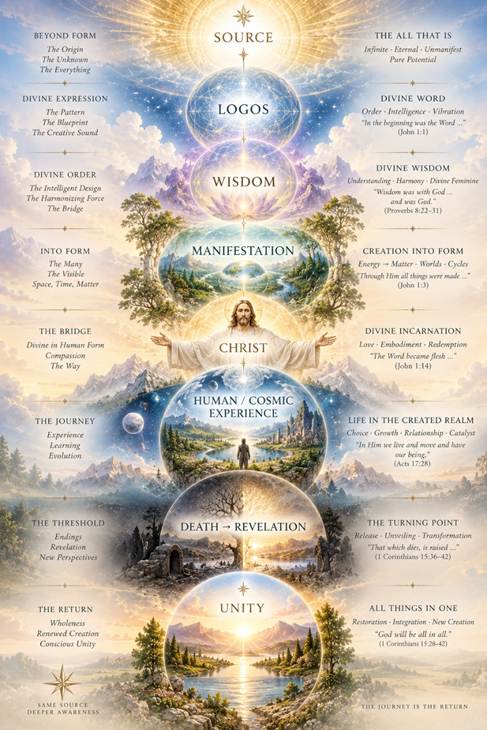
XIII. The Sevenfold Cycle as an Octave
The most fruitful interpretation of the matrix may be cyclical rather than linear. The sequence can be represented as: 1 → 2 → 3 → 4 → 5 → 6 → 7 → 1′, where the second occurrence of 1 represents the beginning of a new octave.
The seven stages become: Will → Polarity → Value → Form → Sacrifice → Revelation → Unity At the beginning, unity is unconscious. At the end, unity is conscious. This produces a fundamental distinction: The beginning and the ending may appear identical while representing entirely different states of awareness.
The first “I AM” represents undifferentiated potential. The final “I AM” represents unity consciously realized after differentiation and transformation.
The seventh therefore does not destroy the first. It returns to the first at another level.
XIV. Elohim and Archons: A Comparative Esoteric Layer
A further layer can be added by comparing the sevenfold biblical structure with traditions involving the Elohim and Archons.
Here methodological caution is essential.
The Bible does not establish a sevenfold correspondence between the Elohim and the Archons, nor does Revelation explicitly identify either group with the Seven Seals. These associations belong to later esoteric synthesis. Nevertheless, they can be explored symbolically. The same sevenfold process may be viewed from two directions.
- The ascending interpretation: The seven stages represent increasing integration: Will → Differentiation → Discernment → Transformation → Integration → Illumination → Unity
- The constraining interpretation: The same stages may be experienced as progressively distorted by identification: Control → Division → Attachment → Identification with Form → Suffering → Collapse of Illusion → Liberation
This creates a useful conceptual polarity:
| Stage | Creative reading | Constraining reading |
| I | Divine Will | Control |
| II | Creative polarity | Division |
| III | Intelligence and discernment | Attachment to value |
| IV | Manifestation | Identification with form |
| V | Sacrifice | Suffering |
| VI | Revelation | Collapse of illusion |
| VII | Unity | Liberation |
The important point is not that these systems are historically identical. Rather, seven functions as a symbolic grammar through which both creation and liberation can be represented.
XV. The Christological Center
The most significant feature of the entire model may be the position of Christ between the transcendent and manifested realms.
The Lamb stands at the center of the Revelation narrative because the Lamb performs the paradoxical act of opening through sacrifice. This connects the fifth seal’s imagery of martyrdom with the broader Christian symbolism of Christ’s death and resurrection.
The pattern becomes: Form → Sacrifice → Death → Revelation → Transformation The Christian paradox is that what appears to be defeat becomes the mechanism of victory. Consequently, the Lamb does not overcome the world by refusing death but by passing through it.
In symbolic terms, the Christic pattern is therefore not simply: Life → Death but: Life → Sacrifice → Death → Resurrection → Transformed Life
This gives the seventh position its ultimate meaning. The goal is not annihilation. It is transformation of the mode of existence itself.

XVI. The Sevenfold Matrix as a Map of Consciousness
Taken as a symbolic system, the matrix can therefore be summarized as follows:
I move… I encounter the Other… I discern what matters… I become embodied… I surrender what can no longer continue… I see what was hidden… I become still…
The seventh then gives rise to another beginning: I move again — but differently. This is the concept of the higher octave.
Conclusion
The Seven Seals of Revelation can be read on several levels simultaneously. Historically and theologically, they belong to the apocalyptic vision of the Book of Revelation and communicate themes of conquest, violence, scarcity, death, martyrdom, cosmic upheaval, judgment, and divine sovereignty. Literarily, they form part of Revelation’s larger architecture of recurring sevens. Symbolically, they can be interpreted as a progression from action through differentiation and crisis toward revelation and sacred stillness.
When placed within a broader sevenfold matrix, the sequence becomes:
Will → Polarity → Value → Form → Sacrifice → Revelation → Unity
The most significant feature of this interpretation is the function of the seventh position. The Seventh Seal does not simply provide a final catastrophe. It produces silence—and from that silence emerges another sevenfold sequence, the Seven Trumpets. The seventh is therefore simultaneously ending and beginning. This gives the Revelation cycle an octave-like structure: Manifestation → Differentiation → Crisis → Transformation → Revelation → Silence → Renewal
The resulting model should not be mistaken for an explicit doctrine of Revelation, nor should its comparisons with Elohim, Archons, or other esoteric systems be presented as historical equivalences. Rather, it represents a comparative symbolic hypothesis: that seven can function as an archetypal architecture through which traditions describe the movement from unity into differentiation, through experience and dissolution, and ultimately toward a renewed form of unity.
In this reading, the apocalypse is not merely the destruction of a world. It is the unveiling of what lies beyond the world as previously understood. And the silence of the Seventh Seal becomes the essential mystery at the center of that process: before the next creation speaks, heaven becomes silent.


Leave a comment